Understanding the Levels of Logistics Management: A Guide for Businesses
- Nov 30, 2025
- 3 min read
Updated: Dec 16, 2025
In today’s rapidly evolving supply chain landscape, businesses face increasing pressure to deliver faster, operate leaner, and meet customer expectations with precision. One effective way to achieve this is by understanding the different levels of logistics management—from 1PL to 5PL—and identifying which model aligns best with your operational goals.
Each level represents a unique degree of outsourcing, digital integration, and strategic partnership. Let’s explore these logistics models together with Hugix to help you choose the right path for your growth.
1PL – First-Party Logistics

1PL is known as a self-operated logistics model. Companies using this approach organize and handle all logistics activities internally to meet their operational needs. They invest in and prepare all necessary resources—such as transport vehicles, warehouses, facilities, equipment, and workforce training—to manage the transportation and storage of goods.
What makes 1PL different from other logistics models is that there is no collaboration with external logistics service providers. This model is commonly used for general types of cargo that are not too large or heavy, typically applied in domestic transportation.
When It Works
This model works best for small businesses with simple supply chains. It suits companies that want full control over how their goods are handled and operations focused on short-distance or localized deliveries.
Limitations
As businesses grow, in-house logistics often becomes expensive and inefficient. Lack of technology, limited resources, and scalability challenges can slow down expansion.
2PL – Second-Party Logistics

2PL is an outsourced logistics model where a second-party provider is hired to perform specific steps in the supply chain. These providers typically handle tasks such as transportation, warehousing, customs procedures, and payment services. Common 2PL providers include shipping lines, airlines, trucking companies, and warehouse operators.
Using 2PL services offers several benefits. It reduces the need for heavy investment in assets and provides access to specialized logistics providers. However, a key drawback is that businesses still need to coordinate and manage multiple partners on their own.
3PL – Third-Party Logistics

3PL can be seen as a more advanced evolution of 2PL. In this model, a manufacturing company outsources all or selected parts of its logistics operations to a third-party provider. These tasks may include packaging, import-export procedures, customs clearance, transportation, loading and unloading, and final delivery.
Typically, 3PL companies operate multiple types of transportation assets—from road to air—and maintain strong partnerships with other carriers. Companies choose 3PL to simplify complex logistics, scale faster without owning assets, and rely on experienced providers with established networks. This model is especially ideal for growing e-commerce brands and import-export businesses.
4PL – Fourth-Party Logistics

4PL is an advanced model built on the foundation of 3PL. It offers a broader scope and a higher level of complexity and responsibility. In this model, the logistics provider acts as the lead logistics partner, centralizing coordination, control, and management of all elements within the customer’s supply chain.
Beyond the standard functions of 3PL, 4PL providers also take on additional roles such as business process management and the integration of advanced information technology into logistics operations. Customers authorize the 4PL provider to manage, optimize, and execute all activities across the logistics supply chain.
5PL – Fifth-Party Logistics

Fifth-party logistics (5PL) is still relatively unfamiliar to many businesses, as it has only emerged in recent years alongside the rapid growth of e-commerce. 5PL providers manage and coordinate the activities of 3PL, 4PL, and other related parties across digital and e-commerce platforms.
They rely on the tight integration of three core systems—Order Management System (OMS), Warehouse Management System (WMS), and Transportation Management System (TMS)—to operate the supply chain efficiently.
Summary of Logistics Models
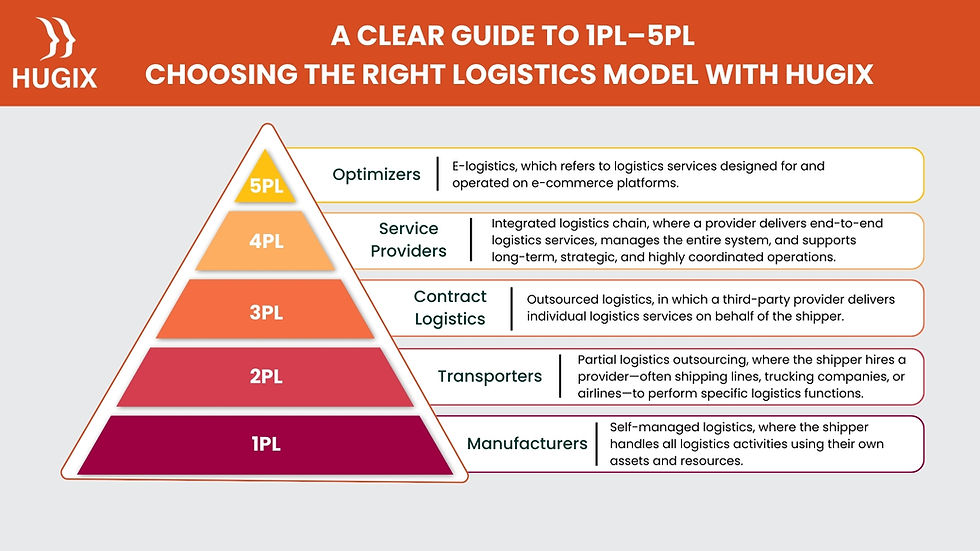
To summarize, here are the characteristics of the five types of logistics services:
1PL: Self-managed logistics, where the shipper handles all logistics activities using their own assets and resources.
2PL: Partial logistics outsourcing, where the shipper hires a provider—often shipping lines, trucking companies, or airlines—to perform specific logistics functions.
3PL: Outsourced logistics, in which a third-party provider delivers individual logistics services on behalf of the shipper.
4PL: Integrated logistics chain, where a provider delivers end-to-end logistics services, manages the entire system, and supports long-term, strategic, and highly coordinated operations.
5PL: E-logistics, which refers to logistics services designed for and operated on e-commerce platforms.
Why Understanding These Levels Matters
Choosing the right logistics model can:
Reduce operational costs
Improve delivery speed and accuracy
Strengthen customer satisfaction
Enhance scalability as your business grows
Free internal teams to focus on core activities
As the logistics world continues to digitalize, understanding the difference between 1PL to 5PL becomes essential to staying competitive. At Hugix, we empower freight forwarders with skilled operational support, helping them streamline processes and scale sustainably. No matter where you are on the PL spectrum, Hugix can help you elevate your logistics journey.
For more information, visit Hugix.


